
A-Frame vs Shed Roof vs Gable: Which Cabin Form Works Best for Your Site?
SHORT TERM RENTALS
5/15/202611 min read
Roof form is the single design decision that determines more about your cabin's cost, interior quality, site performance, and market positioning than any other choice you will make early in the process.
Most people arrive at a roof form through images. They spend time on Pinterest or Instagram, they respond to what they find compelling, and they carry that reference into a design conversation without having assessed whether it fits their site, their climate, their budget, or their target guest. That approach is not irrational — aesthetic response is a real and legitimate starting point. But it becomes a problem when a roof form that photographs beautifully turns out to be structurally inappropriate for a high-snow-load site, or produces an interior volume that does not serve the cabin's program, or costs significantly more to build than the project budget can absorb.
The three roof forms that define the contemporary cabin market are the A-frame, the shed roof, and the gable. Each has a distinct set of strengths, a specific set of failure conditions, and a market perception that affects how it performs as a short-term rental listing. Understanding all three across the same set of variables gives you the basis for a decision that is grounded in your actual site and goals rather than in what looked good on a screen.
The A-Frame
Aesthetics and market perception
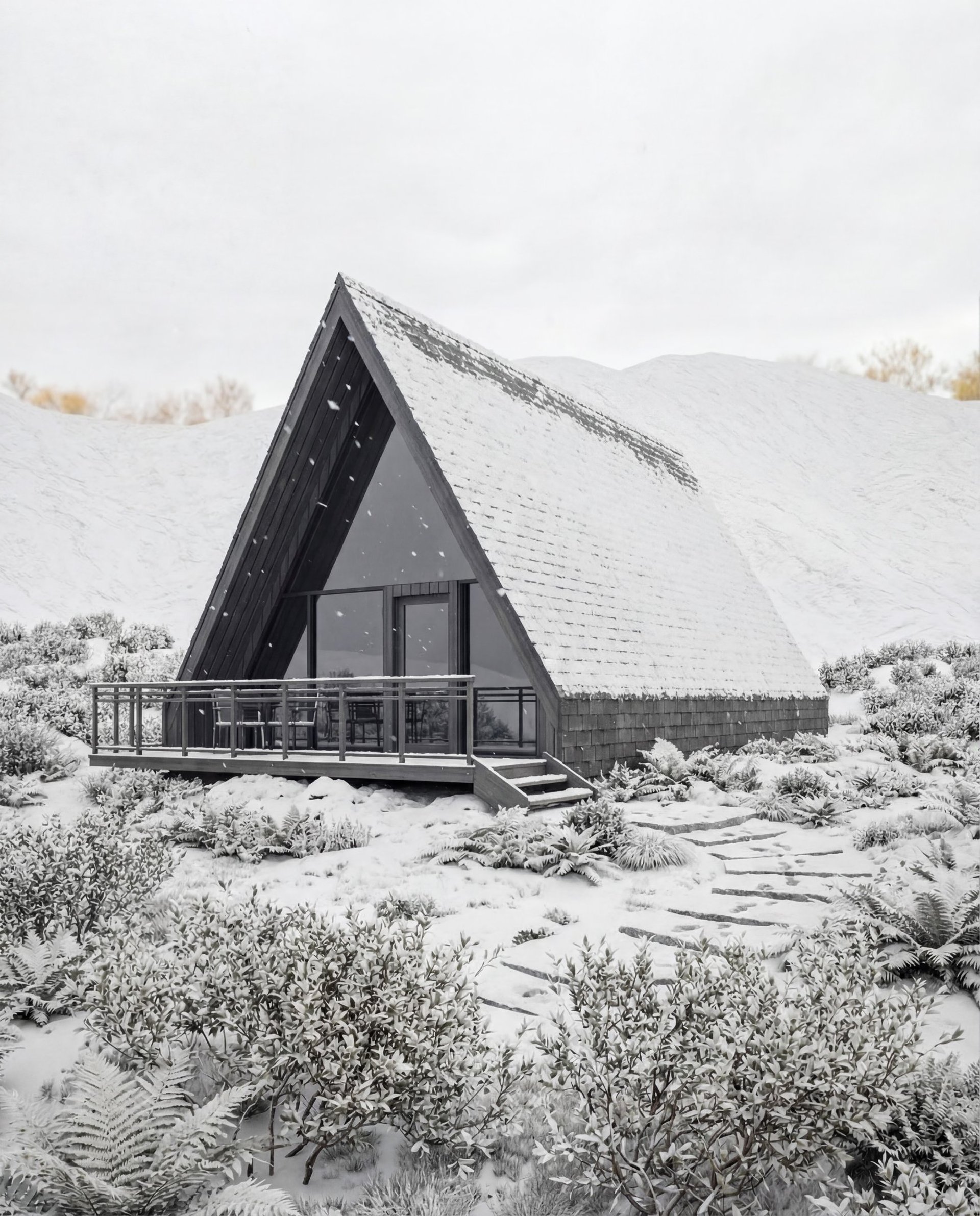
The A-frame is the most recognizable cabin form in the American cultural imagination. It reads immediately as retreat, as escape, as the distilled idea of a cabin in the woods. That recognition has real market value — an A-frame listing photograph communicates its identity before a guest reads a single word of the description. In STR markets where guests are choosing between dozens of options, that instant recognition is a conversion asset. A-frames consistently outperform undifferentiated rectangular cabins on click-through rates on Airbnb and VRBO, and their aesthetic distinctiveness supports a premium pricing position in most markets.
That distinctiveness also has a shelf life question attached to it. The A-frame revival has been running for roughly a decade, and in some markets — particularly the more saturated STR destinations like the Catskills and parts of the Smoky Mountains — the form has moved from distinctive to expected. In those markets, an A-frame is no longer a differentiator; it is baseline. The aesthetic argument for the A-frame is strongest in markets where it is still relatively uncommon, and weakest where every other listing is already one.
Interior volume
The A-frame's interior is its most significant design constraint. The steep pitch that produces the dramatic exterior produces a sharply triangulated interior where usable floor area decreases rapidly as you move away from the ridge. On the ground floor, the full-width open plan reads well and functions well. But the moment you introduce a loft — which most A-frame programs require to maximize bedroom count — you are working with a space where ceiling height at the loft perimeter drops to the point of being uncomfortable for standing adults.
This is not a solvable problem within the form. It is the form. Managing it requires careful loft design that positions sleeping areas rather than circulation or dressing space at the low edges, and it requires a program that accepts the A-frame's inherent trade-off between dramatic volume and practical square footage. An A-frame that tries to push too many bedrooms into its upper level produces a guest experience that feels cramped and awkward regardless of how good the exterior looks.
Build cost
The A-frame is not a low-cost form. The steep structural roof that defines it requires engineered rafters or trusses capable of handling significant loads, and the cladding of the exterior roof face — which on a true A-frame extends to or near the ground — is a large surface area of material and labor. The angular geometry also produces more complex details at every intersection, which adds time and therefore cost to the carpentry phase. On a per-square-foot basis, A-frames generally run higher than a comparable gable cabin, and the cost differential widens on larger footprints where the structural engineering requirements scale up.
The cost of an A-frame is most justifiable when the STR revenue case is strong. In a high-ADR market where the form's listing appeal supports a meaningful rate premium, the additional construction cost can be recovered within a reasonable stabilization period. In a mid-tier market where the rate ceiling is lower, the A-frame's cost premium may not produce a return on the additional investment, and a simpler form may be the financially correct choice even if it is aesthetically less compelling.
Site suitability
The A-frame performs best on sites that allow the full exterior to be appreciated from a meaningful vantage point — a clearing, a slope that drops away from the cabin, or a site with enough setback from treeline to allow the form to read clearly. A dense forest site where the A-frame is essentially invisible from any distance loses most of the form's exterior value. The building's footprint is also relatively compact and fixed by the form, which makes it well-suited to narrower sites where a wider rectangular building would not fit but can be limiting on sites where the program requires a larger footprint.
Snow load performance is one of the A-frame's genuine structural advantages. The steep pitch sheds snow efficiently, which is relevant in high-accumulation markets like the Adirondacks, northern New England, and high-elevation sites in the Rockies. In those markets, a flat or low-pitch roof is a maintenance and structural liability, and the A-frame's pitch is a practical asset as much as an aesthetic one.
The Shed Roof
Aesthetics and market perception
The shed roof — a single-pitch plane that slopes in one direction — is the contemporary form that has grown most significantly in the cabin market over the past five years. Its appeal is architectural rather than nostalgic. Where the A-frame reads as cabin archetype, the shed roof reads as considered modern design, and it attracts a guest profile that is slightly different: more design-aware, less interested in rustic signifiers, more responsive to photography that emphasizes material quality, interior light, and spatial clarity.
On STR platforms, shed roof cabins perform particularly well in markets where the guest base skews toward design-conscious urban travelers. The Hudson Valley, Joshua Tree, and the more accessible parts of the Blue Ridge attract a significant segment of guests who respond to architectural quality as a distinct category of experience. In those markets, a well-executed shed roof cabin can command rates that equal or exceed an A-frame because it is appealing to a different guest motivation — one that is less about the cabin-as-escape narrative and more about architecture as the product itself.
Interior volume
The shed roof's most significant spatial advantage is the high wall it creates on one side of the building, which is almost always oriented to face the primary view or the most favorable light direction. That high wall is typically glazed extensively, producing the floor-to-ceiling window condition that has become one of the most recognizable and marketable features of contemporary cabin design. The volume that results is generous, even-height, and highly usable — there is no triangulation penalty as in the A-frame, and the ceiling plane rises consistently toward the glazed wall, creating a directional quality to the interior that reinforces the connection to the exterior landscape.
Loft integration in a shed roof cabin is cleaner than in an A-frame. The consistent ceiling height allows loft structures to be positioned anywhere in the plan without the low-eave problem, and the high glazed wall can be left unobstructed at full height while the loft sits over the lower portion of the plan on the opposite side. For cabin programs that need to maximize bedroom count without sacrificing the quality of the main living volume, the shed roof handles this more elegantly than any other simple form.
Build cost
The shed roof is generally the most cost-efficient of the three forms discussed here. A single-pitch roof is structurally straightforward — the framing is simpler than a symmetric gable and significantly simpler than an A-frame, with fewer complex intersections and a smaller number of structural members required to span the same footprint. The high glazed wall is the primary cost variable, as floor-to-ceiling glazing is expensive per unit area, but it is a cost that can be scaled with the project budget by adjusting the extent and specification of the glazing rather than changing the form itself.
For STR investors working within a construction budget that needs to deliver a specific return on cost, the shed roof offers the best ratio of architectural impact to build cost of the three forms. The savings on the roof structure relative to an A-frame can be redirected toward the finishes and amenities that most directly affect ADR — materials, fixtures, outdoor spaces, and the wellness amenity stack.
Site suitability
The shed roof is highly adaptable to slope. The single pitch can be oriented to run with the slope or against it, and in either case the relationship between the building and the ground plane is easier to resolve than with a symmetric form. On a site that slopes away from the primary view, orienting the high wall toward the view and letting the roof pitch rise in that direction produces a cabin that feels planted in its site while opening fully to the landscape. This is the condition that produces the best photography and the best guest arrival experience.
In high-snow markets, the shed roof requires attention to drainage at the low eave. A shallow pitch on a shed roof can accumulate snow load, and the drainage condition at the low eave needs to be detailed correctly to prevent ice damming and the water infiltration problems that follow. In markets with significant snowfall, a steeper shed pitch is both safer structurally and more effective as a drainage surface. The form is flexible enough to accommodate a range of pitches, and the right pitch for a given climate should be determined early in the design process rather than after the structural system is set.
The Gable
Aesthetics and market perception
The gable roof is the most traditional cabin form and the most universally legible. Two symmetric pitches meeting at a central ridge, a triangular end wall, and a plan that reads as simple, stable, and resolved. Its familiarity is both its strength and its limitation. The gable does not produce the immediate aesthetic signal of an A-frame or the architectural specificity of a shed roof, but it also does not carry those forms' constraints. It is a neutral and highly adaptable framework that can read rustic, modern, or contemporary depending entirely on the materials and details applied to it.
In STR markets, gable cabins are the hardest to differentiate in listing photography if the design is treated generically. A gable cabin clad in generic wood siding with a standard composition shingle roof looks like what it is: a conventional build that could be almost anywhere. But a gable cabin designed with intention — in Shou Sugi Ban cladding, with a standing seam metal roof, generous glazing in the end gable walls, and a covered outdoor room extending from one side — photographs extremely well and commands strong guest interest. The form is not the differentiator; the execution is.
Interior volume
The gable's interior volume is determined by the pitch and the span. A high-pitch gable on a moderate-width plan produces a dramatic vaulted interior that rivals the A-frame's spatial quality without the triangulation penalty at the loft level. A low-pitch gable on a wide plan produces a more utilitarian interior with less spatial drama but more usable floor area. The gable gives the designer the most control over interior volume of the three forms because both pitch and span can be adjusted independently to produce the desired spatial result.
The end gable walls are the gable form's most underused design opportunity. A full-height glazed gable wall facing a primary view produces one of the most compelling interior conditions available in cabin architecture — a wall of glass that reads as a frame for the landscape and fills the interior with directional light. This condition is achievable without any structural complexity because the gable's structural system positions the ridge beam to support glazing rather than obstruct it. Cabins that exploit this condition consistently outperform those that treat the end walls as opaque surfaces.
Build cost
The gable is the most cost-predictable form to build. Its structural logic is well understood by framing crews across all markets, material take-offs are straightforward, and there are few of the complex geometric conditions that add labor time to an A-frame build. On a per-square-foot basis, a gable cabin with a competent design and standard materials runs at the lower end of the cost range among the three forms, which makes it the most accessible starting point for investors working with tighter development budgets or for homeowners who want to allocate more of their budget to finishes and amenities rather than structural complexity.
The gable also scales well. It is the form most easily extended through additions, connected volumes, and secondary masses. A primary gable cabin with a subordinate gable outbuilding — a separate sleeping bunk, a dedicated wellness structure, or a covered outdoor room under its own gable — is a compositional approach that produces a campus-like site plan with genuine design quality and a build cost that can be phased over time. That phasing flexibility has real value for investors who want to start with a functional cabin and add amenities as revenue stabilizes.
Site suitability
The gable's adaptability to site conditions is its most practical advantage. It performs well on flat land, on moderate slopes, in high-snow environments (the symmetric pitch sheds snow evenly from both sides), in coastal and lakefront conditions, and in dense forested sites where a compact rectangular plan is the right response to a constrained buildable area. There is no site type where the gable is the wrong structural answer, which makes it the default form when site conditions are complex or when the design priorities are driven by program and budget rather than a specific formal aspiration.
In wooded mountain sites where the cabin sits in a clearing with no single dominant view direction, the gable is often the most resolved choice because it does not commit strongly to a single orientation. The A-frame and shed roof both have inherent directionality — they read best and perform best when aligned with a specific view or light condition. The gable reads well from multiple directions, which is an advantage on sites where the arrival sequence, the outdoor spaces, and the primary views do not all come from the same direction.
How to Make the Decision
The right roof form for your cabin is the one that best resolves the specific conditions of your site, your program, your climate, and your budget. That sounds obvious, but in practice the decision is frequently made before any of those factors are fully understood, which is why so many cabins end up fighting their own form rather than being completed by it.
If your site is a high-elevation mountain parcel with significant snow load and a single dominant view condition, the A-frame's pitch and directional quality are genuine assets. If your site is a wooded or lakefront parcel where architectural quality and interior light matter most, the shed roof's spatial generosity and glazing capacity are the right tool. If your site is variable in its conditions, your program is large or phased, or your budget needs to prioritize finishes over structure, the gable's flexibility and cost efficiency make it the strongest platform to work from.
The form itself is the starting point, not the outcome. An A-frame that is detailed carelessly looks cheap. A gable that is executed with precision and material intelligence looks exceptional. The form sets the constraints and the opportunities. What happens within those constraints is what actually determines the quality of what gets built.
Frequently Asked Questions
Does roof form significantly affect construction cost, or is it a relatively minor variable?
It is a significant variable, and the gap widens on larger footprints. On a small cabin of 600 to 800 square feet, the structural cost difference between an A-frame and a gable might be $8,000 to $15,000. On a larger cabin of 1,500 to 2,000 square feet, that differential can reach $25,000 to $40,000 or more, depending on the engineering requirements and the complexity of the roof geometry. The shed roof typically sits at or below the gable in cost, making it the most efficient option when architectural impact per construction dollar is a priority. These numbers should be modeled explicitly in any development budget rather than treated as a rounding error.
Which roof form photographs best for STR listings?
All three photograph well when designed and executed with intention, but they photograph well for different reasons and attract different guest responses. The A-frame produces the most immediately recognizable hero shot and performs best as a thumbnail on STR platforms where a guest is making a fast decision. The shed roof photographs best in interior-focused images that emphasize light, volume, and the relationship to the landscape — it rewards guests who look beyond the thumbnail. The gable's photographic performance is most dependent on material and detail quality; a generic gable is forgettable, but a well-detailed gable with a strong material palette photographs as well as either of the other forms. For STR investors, the honest answer is that listing photography quality and styling matter more than roof form in isolation.
Can I combine roof forms on a single cabin, or is that a design mistake?
Combining forms is common in cabin design and often produces the most spatially interesting results, but it requires compositional control to avoid looking arbitrary. The most successful combinations treat one form as the primary volume and the other as a subordinate addition — a main gable mass with a shed-roof covered porch, or a shed roof primary volume with a lower gable outbuilding. Where combinations go wrong is when two forms of similar scale compete with each other without a clear hierarchy, producing a roofline that reads as unresolved rather than considered. If you are exploring a combined form, the question to keep asking is which volume is primary and which is secondary, and whether the relationship between them is clear from every approach to the building.
© 2025. All rights reserved.
Ohmees is a wholly owned subsidiary of KHALIQ DESIGN STUDIOS Ltd Liability Co.