
What Cabin Floor Plans Actually Work for Short Term Rentals vs Personal Use
SHORT TERM RENTALS
5/15/202611 min read
The floor plan decision that feels like a personal preference is actually a performance decision, and getting it wrong costs you either in occupancy or in livability depending on which direction you miscalibrate.
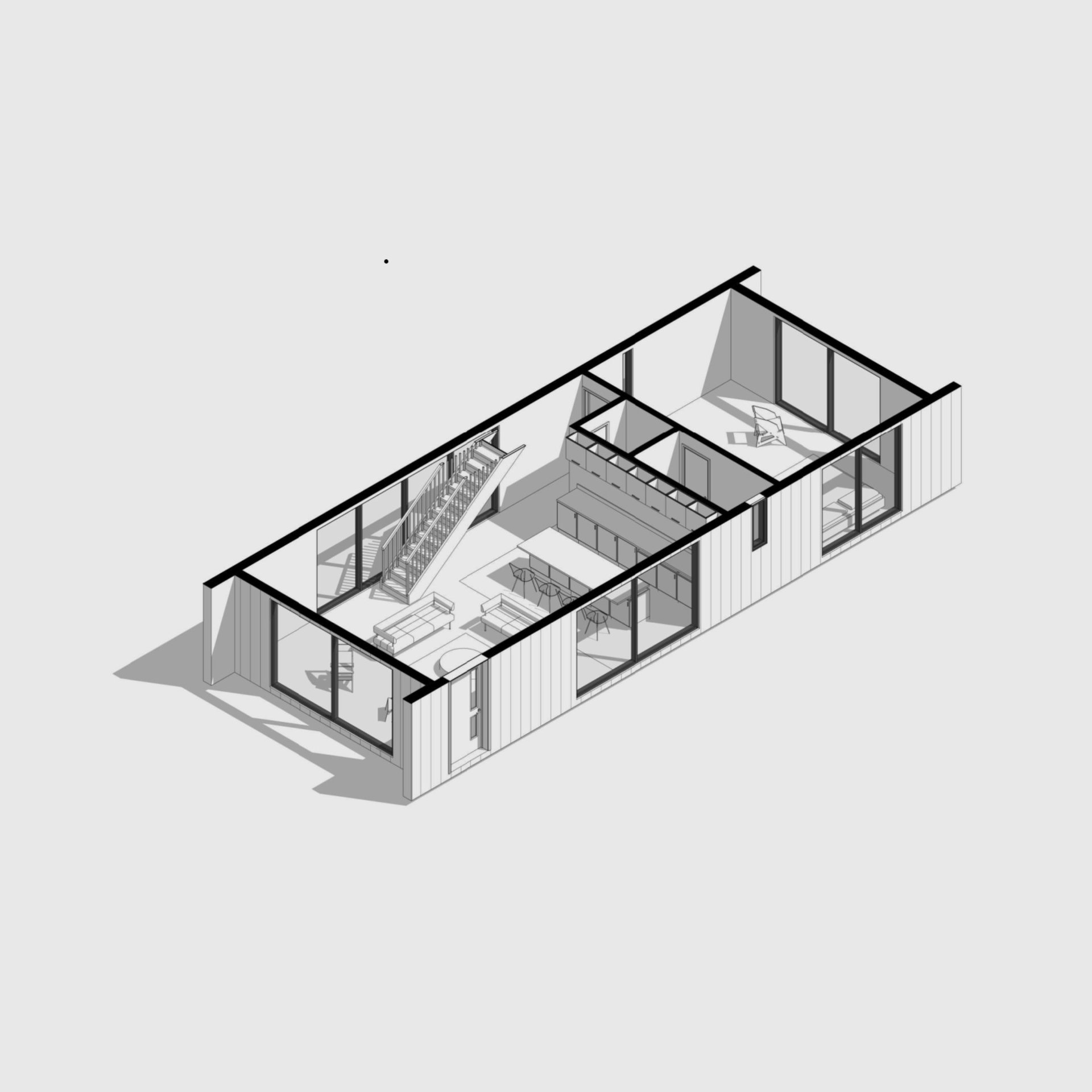
Most cabin floor plans are chosen by looking at what has been done before. A three-bedroom layout with an open-plan kitchen and living area, a loft, and a covered deck. It is a reasonable starting point, but it is also a layout that was not designed for either use case with any precision. It performs adequately as a rental and adequately as a personal retreat, which means it was optimized for neither. Understanding where the spatial priorities of STR design and personal-use design diverge, and where they genuinely align, is what separates a cabin that performs from one that simply functions.
The stakes are different depending on your situation. For an STR investor, a floor plan that underdelivers on guest capacity, privacy, or the experience of arrival and outdoor connection translates directly into a lower rate ceiling and a longer path to a stabilized return. For a personal homeowner, a floor plan borrowed from rental logic produces a cabin that is excellent for guests but subtly uncomfortable to actually live in over time. The goal of this post is to map out where those two sets of priorities pull in different directions, where they point the same way, and how to make a deliberate choice rather than defaulting to the standard layout.
How STR Guests Actually Use a Cabin
To design well for short-term rental, you need to start with how guests use the space rather than how a homeowner would. The differences are more significant than they first appear.
STR guests arrive in groups. The overwhelming majority of cabin bookings are group travel — couples, families, friend groups, and multi-generational gatherings. A couple booking a two-night stay behaves very differently from a family of eight booking a long weekend, but both have something in common: they are sharing a space with people they already know and have chosen to travel with. The spatial implication is that the common areas need to work for groups, which means scale and circulation matter in ways they do not for a single occupant or a couple living alone.
STR guests are also on a compressed timeline. They arrive, they settle in, they want to immediately access what they came for — the hot tub, the view, the fire pit, the sauna. The arrival experience and the transition from inside to outside are experienced intensely because the stay is short. A floor plan that makes guests feel the cabin is delivering its value immediately performs better than one that requires time to appreciate. This has direct implications for where the key experiential features sit in relation to the entry, the main living area, and the outdoor spaces.
Guests do not maintain the cabin during their stay the way a homeowner would. They do not tidy constantly, they do not store things in an organized way, and they frequently use every room simultaneously when a large group is present. A floor plan that functions well under those conditions has enough storage to absorb a group's gear without the spaces feeling cluttered, has bathrooms positioned to serve multiple rooms rather than requiring long circulation paths, and has bedrooms that provide acoustic privacy from each other and from the main living area so that guests on different schedules are not disrupting each other.
The STR Floor Plan: What the Numbers Demand
Short-term rental revenue is driven more directly by floor plan decisions than most investors realize at the planning stage. The two variables that matter most are guest capacity and bathroom ratio, and both are determined by the floor plan before a single material is specified.
Guest capacity is the primary driver of ADR in cabin markets. A cabin that sleeps eight commands a meaningfully higher rate than a cabin that sleeps four, and the rate premium for the additional capacity is almost always larger than the proportional cost of adding it to the build. In most high-demand STR markets, the difference in achievable ADR between a four-guest cabin and an eight-guest cabin is not two times — it is often two and a half to three times, because larger group bookings are less price-sensitive and because the pool of available cabins that serve larger groups is smaller. Building guest capacity into the floor plan from day one is one of the highest-return decisions an STR investor can make, and it is a decision that cannot be added later without a significant addition.
Maximizing guest capacity in a cabin floor plan does not mean adding bedrooms indiscriminately. It means thinking carefully about the hierarchy of sleeping spaces. A primary bedroom suite with a dedicated bathroom serves guests who want privacy and are often the ones organizing and paying for the trip. Secondary bedrooms with shared bath access serve additional couples or family members. A bunk room or sleeping loft serves the lowest-cost-per-head capacity — children in a family booking, or the additional guests in a friend group who are happy to share a more casual sleeping space in exchange for a lower per-person cost. A floor plan that includes all three of these sleeping typologies achieves the highest guest count with the least compromise to the experience of the guests who are most discerning about their accommodation.
Bathroom ratio is the variable that guests notice most acutely when it is wrong. A cabin that sleeps eight with two bathrooms works but will generate friction — particularly for larger groups where morning routines overlap. A cabin that sleeps eight with three bathrooms, or two full bathrooms and one additional half bath adjacent to the primary outdoor space, removes that friction entirely. Adding a bathroom to a new build costs a fraction of what it costs to add one later, and the occupancy and review score impact of adequate bathroom provision is consistent across markets. STR investors who treat bathroom count as a budget line to reduce are making a false economy.
The outdoor connection is the other floor plan variable that directly affects STR performance and is frequently underweighted in the design phase. A cabin floor plan that allows guests to move from the main living area directly to the outdoor deck, hot tub, or fire pit area without a complicated circulation path performs better than one where the outdoor amenities feel appended rather than integrated. The best STR floor plans treat the indoor and outdoor spaces as a continuous social zone, with the transition point designed as carefully as the rooms themselves. Wide sliding or folding doors, covered outdoor areas adjacent to the main living volume, and a clear sightline from the kitchen to the outdoor entertaining space are the spatial decisions that make a cabin feel larger than its square footage and more connected to the landscape than its footprint alone would suggest.
The Personal-Use Floor Plan: What Livability Actually Requires
A cabin designed primarily for personal use answers to a different set of questions. The spatial logic shifts from maximizing guest experience during a short, intense stay to supporting the rhythms of actual living over time — different seasons, different moods, different activities, and different ways of being alone or together.
The most important reframe for a personal-use cabin floor plan is the difference between social space and retreat space. An STR floor plan is optimized almost entirely for social space — open plans, large common areas, outdoor entertainment zones. A personal-use floor plan needs to provide genuine retreat space alongside the social areas. A reading nook with good light and acoustic separation from the main living area. A workspace that can be closed off without disrupting the rest of the cabin. A primary bedroom that is positioned to feel separate from the rest of the plan rather than simply a room off the main corridor.
This distinction matters because people who use their cabin regularly — weekends, summers, extended stays — eventually find that a fully open, fully social floor plan becomes tiring to inhabit alone or as a couple. The openness that photographs so well and that guests appreciate during a two-night stay becomes an absence of privacy and a lack of spatial variety over a longer period. Personal-use cabins that endure as places people actually want to return to have layered spatial experiences rather than a single large open room, even if the primary volume is generous.
Storage is the other area where personal-use floor plans consistently outperform STR-optimized plans. STR guests bring gear for a long weekend. Personal homeowners bring gear for every season of every year they own the cabin. Ski equipment, kayaks, fishing gear, tools, firewood, seasonal decorations, extra bedding, kitchen equipment that does not need to be on the counter every day — a personal-use cabin that has not allocated adequate storage for all of that ends up feeling cluttered and compromised within the first year of ownership. The mudroom is the most underrepresented space in cabin design relative to its importance in personal-use livability. An entry sequence that allows gear to be staged, stored, and dried before it reaches the main living area is not a luxury in a cabin that is used for outdoor recreation — it is a functional necessity.
The kitchen in a personal-use cabin can and should be more serious than a typical STR kitchen. STR operators rightly specify durable, visually appealing kitchens with enough capacity to serve a large group, but the cooking experience is secondary because most STR guests cook relatively simple meals or order in. Personal homeowners who use their cabin regularly often use it for the kind of extended, unhurried cooking that is part of the appeal of cabin life. A kitchen with adequate counter space, good light, a serious range, and a layout that makes cooking for a group enjoyable rather than merely possible is a meaningful livability upgrade in a personal-use cabin.
Where the Two Floor Plans Align
The differences between STR and personal-use floor plans are real but should not be overstated. There is a significant zone of alignment where the same design decision serves both purposes, and understanding that zone is what makes it possible to build a cabin that works well as a rental and as a personal retreat without major compromise in either direction.
The indoor-outdoor relationship is the most important area of alignment. A well-designed transition from the main living area to a covered outdoor space with views and amenities is equally valuable for a guest group spending a weekend and for a homeowner spending a month. The investment in getting that transition right — the door system, the covered outdoor room, the material continuity between inside and outside — pays returns in both use cases.
Bedroom privacy is another area of genuine alignment. Guests want bedrooms that feel separate and acoustically insulated from each other and from the main living area. Personal homeowners want the same thing, particularly if the cabin is used with family members or friends on a regular basis. A floor plan that positions bedrooms away from the main living volume, with adequate acoustic separation, serves both groups well and should be a standard rather than a premium consideration in any cabin design.
The quality of natural light throughout the plan is the third alignment point. Cabins that feel alive with daylight — that have east-facing windows to catch morning light, south or west exposure in the main living area, and bedrooms that do not feel like windowless boxes — are more appealing to guests and more pleasant to live in over time. This is a design decision that costs nothing structurally and delivers disproportionate value in both contexts.
The Hybrid Floor Plan: Building for Both
For the growing number of cabin owners who are building with both personal use and STR income in mind, the hybrid floor plan is not a compromise — it is a specific design approach that requires deliberate decisions rather than hoping that a generic layout will serve both purposes adequately.
The most effective hybrid floor plan separates the primary owner suite from the guest sleeping areas in a way that functions for both use cases. When the cabin is operating as a rental, the full sleeping program is available to guests. When the owners are in residence, the primary suite functions as a private zone that is genuinely removed from the rest of the cabin's activity. This is best achieved by positioning the primary suite at one end of the plan or on a separate level, with its own bathroom and with enough acoustic separation from the secondary bedrooms and the main living area to feel like a genuine retreat within the building.
A lockable owner's storage zone is a practical inclusion in any hybrid cabin that is often omitted because it feels like a small detail. Over the course of operating a cabin as a rental, the accumulation of items that belong to the owner but should not be available to guests — personal documents, off-season gear, wine and spirits, equipment — becomes significant. A dedicated locked storage room or closet sized for that purpose avoids the situation where the owner either removes everything before each rental period or leaves personal items in spaces where guests can access them.
The hybrid floor plan also benefits from a kitchen specified at a level that serves both guest groups and personal use well. That means more storage and counter space than a minimum STR kitchen, a layout that is intuitive for guests who have never been in the space before, and appliance quality that reflects the cabin's overall positioning rather than the cheapest option that will pass a guest inspection.
Making the Decision
The floor plan decision does not need to be made in the abstract. It needs to be made in relation to three specific things: your primary use case, your site, and your budget allocation.
If STR income is your primary objective, the floor plan optimization is clear. Maximize guest capacity through a hierarchy of sleeping typologies, achieve a bathroom ratio that eliminates friction for large groups, and invest in the indoor-outdoor connection as a core spatial feature rather than a finishing detail. Accept that the personal-use livability elements are secondary and design accordingly.
If personal use is primary and occasional rental is incidental, invert those priorities. Design for the way you actually live — for retreat space, for storage, for a kitchen that works for extended stays, for a floor plan that has spatial variety rather than a single open volume. The cabin will still rent well because the quality and spatial generosity that make it a good place to live also make it a good place to visit, but the optimization is not pointed at the rental calendar.
If both purposes are genuinely equal, the hybrid approach described above gives you the framework. The investment in a primary suite that functions as an owner retreat, adequate owner storage, and a kitchen that works for both use cases is modest relative to the total build cost and significant relative to the lived experience of actually using the cabin over years of ownership.
The floor plan is where the cabin's performance is set. Everything that comes after — the materials, the finishes, the amenities, the outdoor spaces — is building on top of a spatial foundation that was either designed for your situation or borrowed from a generic template. It is worth the deliberate attention.
Frequently Asked Questions
How many bedrooms and bathrooms should a cabin have to maximize STR revenue?
In most high-demand cabin markets, the sweet spot for STR revenue optimization is three to four bedrooms with a bathroom ratio of at least one bathroom per two bedrooms, with an additional half bath serving the main living area and outdoor spaces. A three-bedroom, two-bathroom cabin with a sleeping loft that brings guest capacity to eight to ten is a common and high-performing configuration because it serves both family bookings and friend group bookings without requiring a very large footprint. Beyond four bedrooms, the guest pool narrows somewhat and the build cost increases significantly, so the incremental revenue per additional bedroom decreases. The better investment above four bedrooms is typically adding amenities rather than additional sleeping spaces.
Does an open floor plan always perform better for STR than a divided layout?
Open plans perform better for social gathering and for the photographic presentation of a cabin, but fully open plans have real limitations in multi-bedroom STR cabins. When six to eight guests are present and some want to sleep while others want to stay up, an entirely open plan creates acoustic problems that generate negative reviews. The highest-performing STR floor plans are open in the main living and kitchen zone but have bedrooms that are acoustically separated from each other and from the common areas. The goal is a plan that reads as open and generous in the listing photography and in the arrival experience, but that has enough spatial separation in the sleeping areas to accommodate the different schedules and noise tolerance levels of a mixed guest group.
Is it worth paying more for a larger floor plan, or is it better to invest that money in amenities?
This depends on where you are in the capacity range for your target market. If your current program sleeps four and the competitive set in your market is dominated by cabins that sleep six to eight, adding floor area to increase guest capacity is the higher-return investment because it expands your addressable booking pool and your rate ceiling. If you are already at or above the average guest capacity for your market, additional floor area has diminishing returns and the better investment is in the amenity stack — a sauna, a better outdoor entertainment setup, or a material and finish upgrade that allows you to charge a premium within your capacity tier. The floor area question and the amenity question are both ultimately about where the marginal investment produces the most rate and occupancy upside, and that answer is market-specific.
© 2025. All rights reserved.
Ohmees is a wholly owned subsidiary of KHALIQ DESIGN STUDIOS Ltd Liability Co.